
- Milling wins on speed and material removal; EDM wins on corners, thin features and hard stock
- A mill leaves a corner radius equal to the tool; the wire leaves a sharp corner
- EDM holds ±0.002 mm on hardened material, with a finer but slower surface
- The cheapest answer is often a hybrid: rough with the mill, finish with the wire
Five dimensions to compare them on
| CNC Milling | Wire EDM | |
|---|---|---|
| Reachable geometry | 3D surfaces, pockets, threads | 2D profiles, sharp corners, thin slots |
| Tolerance | ±0.003 mm | ±0.002 mm |
| Surface finish | Milling marks, then finish ops | Fine, layered — no burr |
| Material removal rate | High | Low — slow |
| Hardened material | Hard on tools | Indifferent |
The table tells the story: the two processes are strong where the other is weak. The mistake is forcing one to do the other's job — milling a sharp internal corner is impossible, and EDM roughing a deep pocket is expensive.
Where milling wins

Three-dimensional geometry — pockets, bosses, threads, contoured surfaces — is milling's home. It removes material fast and produces the bulk of almost every machined part. When the feature is reachable by a tool and the material is not hardened, milling is almost always the cheaper route.
Where wire EDM wins
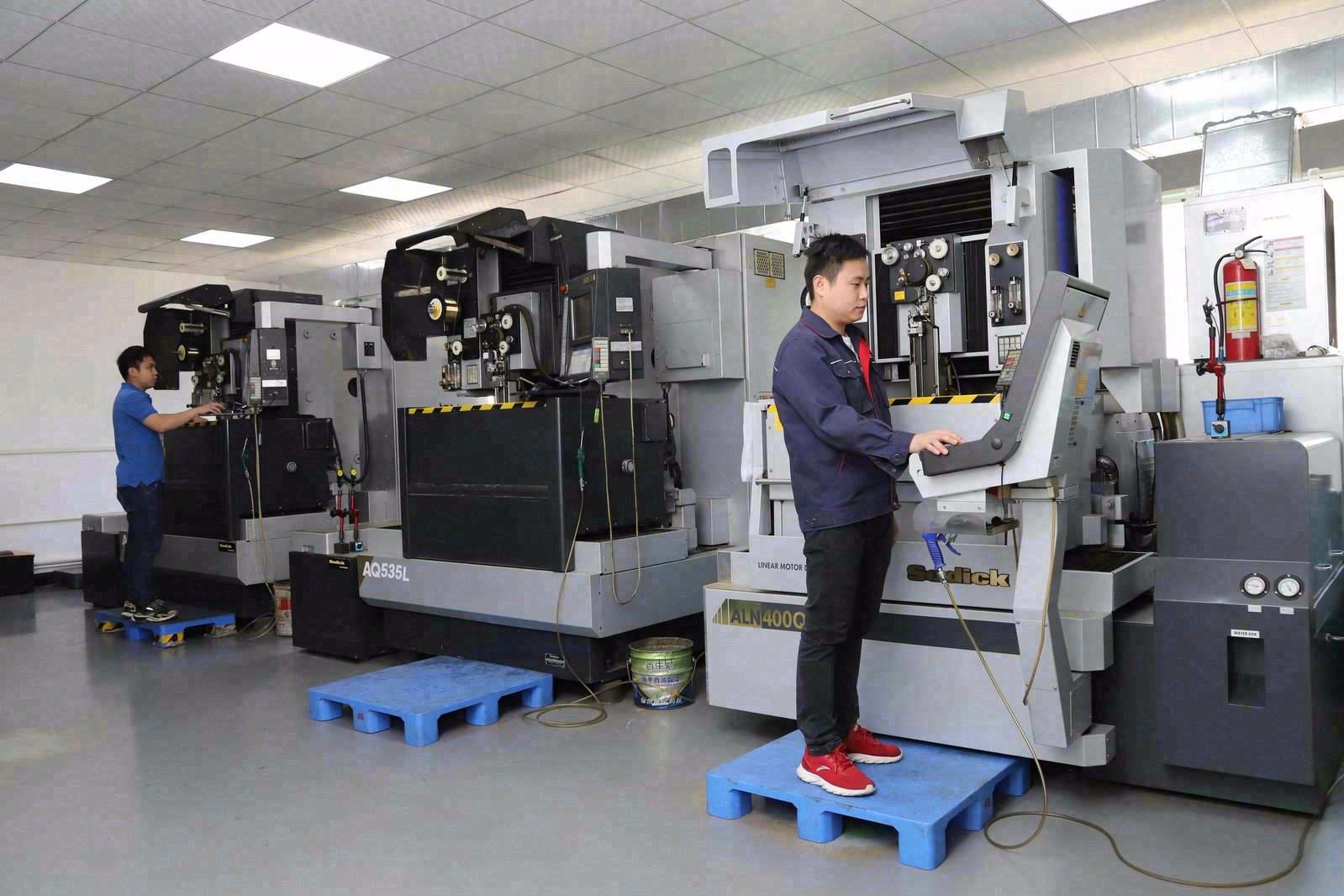
Sharp internal corners, thin fins, sub-millimetre slots, and any precision feature in material that is already hardened. EDM also cuts without burr and without inducing stress, which matters on delicate geometry where a mill's cutting force would deflect the wall.
The hybrid that usually wins
For a part with a sharp internal feature in a larger body, the economical route is: mill the body, heat-treat if needed, then wire-EDM the precision feature. This is not a compromise — it is the standard way tooling and precision mechanisms get made, and it is exactly the combination a single floor with both processes can sequence without hand-off.
Is wire EDM more expensive than milling?
Per feature, often yes — it is slow. But for a sharp corner or a hardened feature, EDM is the only way, so 'expensive' is the wrong frame. The question is whether the geometry needs it.
Can one shop do both?
Yes, and it should. Splitting milling and EDM across two suppliers adds a hand-off where tolerance drifts. We run both, plus grinding, under one roof.
Tell us the feature and the material — we will tell you which process wins, or how to combine them.
Send a 3D file to [email protected] · +86 13126536955
Continue reading: Wire EDM Machining Services · Machining Shop · Wire EDM Tolerances and Surface Finish
Standards referenced on this page
- ISO 9001 — Quality management systems — Requirements
- ASTM E8/E8M-21 — Standard Test Methods for Tension Testing of Metallic Materials