
Medical Machining: Geometry, Micro-Features, and the Document Trail a Device Maker Needs
Medical machining is ordinary machining with an unusual requirement: every part must be able to prove where it came from. The geometry itself is often small and delicate — pins, screws, instrument shafts, implant components, and housings cut from titanium, 316L stainless, and PEEK — and the tolerances are tight but not exotic by precision-machining standards. What separates medical work from every other industry is the document trail: the material certificate, the lot identity, the measured values, and the process record travel with the part, because a device maker cannot release a component it cannot trace. This guide covers which medical parts belong on a machining floor, how their geometry picks the process, what the materials demand, the tolerances and surfaces that hold, and where the regulatory line sits between a component machinist and the device manufacturer.
Which Medical Parts Are Machined, and What Do They Demand from the Process?
Machined medical parts fall into a small number of geometry families, and each family stresses a different part of the machining process. Knowing which family your part belongs to tells you what to specify and what to expect back.
- Small turned and Swiss-type parts. Pins, bone screws, threaded inserts, and implant screws — small, long relative to their diameter, and frequently made on Swiss-type lathes, which feed bar stock past a fixed tool and hold a thin diameter straight over a long length. These are the parts where a 0.1 mm difference in a thread form or a tip is a functional failure, not a cosmetic one.
- Surgical instruments. Scissors, forceps, drivers, and hand-piece components — prismatic and mixed geometry that mills and mill-turns well, with cutting edges, mating surfaces, and finger-grip features that must feel right and clean easily. Surface finish and edge condition are functional here in a way they rarely are elsewhere.
- Implant components. Joint and trauma implants or their trial components, machined from titanium alloys, then often passed to specialized partners for the surface treatments and finishing that a regulatory submission requires. The machining contribution is geometry and tolerance; the biological claims belong to the device maker.
- Device housings and manifolds. Pump bodies, valve blocks, and housings for diagnostic and therapeutic equipment, machined from aluminum, 316L, or PEEK, with sealing faces and ports that must hold size and finish.
The common demand across all four families is not one magic tolerance — it is documented consistency. A medical part is machined, measured, and recorded so that a lot can be recalled, a failure can be traced, and an audit can read the history of a single screw. That requirement shapes the shop choice more than any dimension on the drawing.
Turning, Milling, or Swiss-Type: How Does a Medical Part's Geometry Pick the Process?
Medical parts follow the same geometry logic as every other machined part — round to a lathe, prismatic to a mill, mixed to a mill-turn — with one addition: the smallest and longest medical parts belong to Swiss-type turning, a specialization of the lathe family that most general machining shops also offer.
Swiss-type turning is the process behind the smallest long parts: bone screws, pins, and implant screws down to diameters that a conventional lathe cannot hold straight. The bar is fed through a guide bushing, and the tools cut close to the bushing, so the part does not deflect the way a long slender shaft would on a conventional lathe. When a drawing carries a long thin diameter, a fine thread, and a total length many times the diameter, Swiss-type is usually the answer, and the question to hear back from a shop is not "do we have a lathe" but "which turning platform holds this part straight."
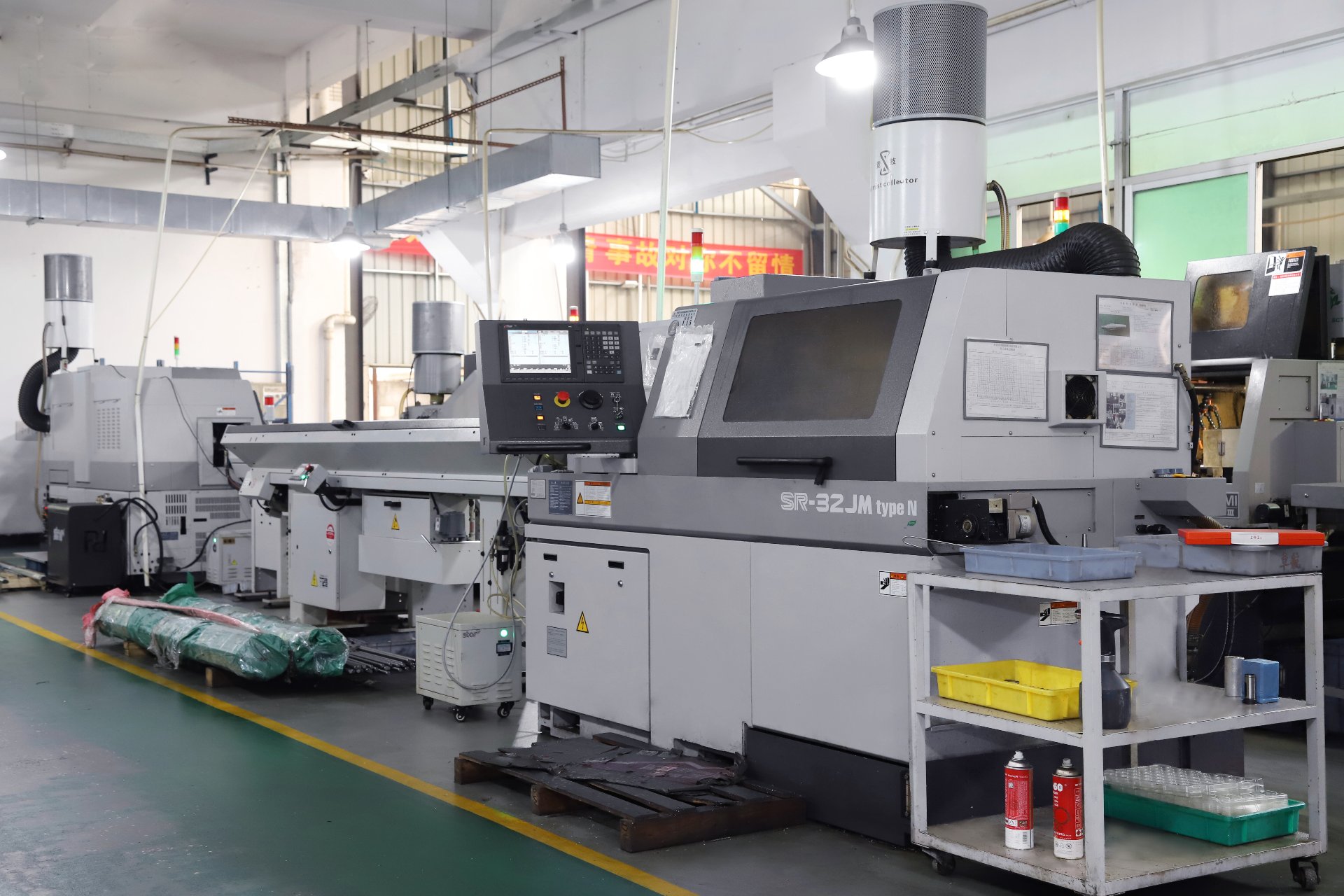
Turning and milling cover the rest. Conventional turning makes the larger cylindrical parts and the threaded bodies that Swiss machines would be slow to produce; milling makes the prismatic instruments, housings, and fixture plates; mill-turn makes the mixed parts where a bore and a face must hold a relationship in one setup. The facility behind this guide runs milling, turning, mill-turn, and grinding across its 100+ CNC machines, with Swiss-type turning in the mix, so a medical part is not forced onto the wrong process because that is all the shop owns.
The process conversation that matters on a medical drawing is the same one as everywhere on this site: which process path does the geometry call for, and where are the datums? On medical parts the answer is rarely exotic — it is a round part on a lathe, a long thin round part on a Swiss, and a blocky part on a mill — but getting it right is the difference between a first article that passes and a first article that teaches you why the process matters.
Which Materials Do Medical Machined Parts Use, and What Does Each One Require?
Medical machining concentrates on a short list of materials, and each one brings its own machining and documentation demands. All three below are in the regular run list of the facility behind this guide.
| Material | Typical medical use | What machining must deliver |
|---|---|---|
| Titanium (TC4 / Ti-6Al-4V, TA2 Grade 2) | Implant components, trauma screws, long-term devices | Slow, heat-controlled cuts to protect surface integrity; verified alloy by XRF against the mill certificate |
| 316L stainless | Instruments, fasteners, short-term devices, anything autoclavable | Work-hardening controlled by real depth of cut; passivation after machining to restore the surface |
| PEEK and other medical polymers | Insulators, housings, and parts where metal is the wrong answer | Sharp tools and controlled heat so the polymer does not melt or smear; burr-free edges |
The material requirement is twofold. First, machining behavior: titanium wants the slow, heat-managed cutting covered in this site's titanium guide, 316L wants the passivation and grade discipline covered in the stainless guide, and PEEK wants nothing that burns or smears it. Second, documentation: the drawing's material line and the mill certificate must name the same alloy, and the incoming lot should be verified before it is cut. A device maker who cannot show the material history of a component has no defense if the component ever fails.
What Tolerances and Surface Finishes Do Medical Parts Need, and Where Are They Earned?
Medical machining holds the same precision bands as any serious machining work: turning and milling to ±0.003 mm on critical features, with precision grinding at ±0.002 mm where a mating or sealing surface demands it. What changes on medical parts is not the tolerance — it is how many features are critical, how small the parts are, and how the surface is specified.
- Small parts concentrate the tolerances. A 2 mm implant screw carries thread form, head geometry, and a tip on a part that fits on a fingertip. Measuring those features needs the right instruments — CMM for datums and diameters, and often optical or vision measurement for the fine features a touch probe would distort.
- Surface finish is functional, not cosmetic. An instrument that must clean easily, an implant surface with a specified roughness, and a sealing face on a pump body all carry Ra requirements that the drawing should state where they function. The as-machined surface of titanium and 316L is already useful; the drawing should say where it is not enough.
- Edges and burrs are quality attributes. A burr on an implant screw or a sharp edge on an instrument is a clinical risk, not a cosmetic defect. Deburring and edge-breaking are part of the medical machining scope, and they belong on the quote rather than being discovered at incoming inspection.
None of this demands a separate, looser "prototype tolerance." It demands measurement and records: first-article inspection against every critical dimension, in-process checks rather than a final sort, and CMM reports that show measured values against the drawing. The quality system behind this facility runs exactly that way, with process capability of Ppk ≥ 1.67 initial held on key characteristics.
What Documentation Ships with a Medical Machining Order, and What Does an Audit Actually Read?
A medical machining order is judged by its paper trail, and the trail has a small number of fixed elements. Knowing what they are lets a buyer check a shipment the way an auditor would.
- The material certificate. Names the alloy, condition, and lot or heat identity of the stock. It is the starting point of the chain, not the proof — the proof is the receiving check that verified the lot against the certificate.
- The receiving and verification record. An XRF check at intake compares the incoming material's elemental fingerprint to the certificate. The facility behind this guide runs that check on every incoming lot, so the alloy on the drawing is verified before the first chip is cut.
- The lot record. Which lot of material, on which machine, in which batch, produced which parts. When the certificate, the receiving check, and the batch identity tie to the same part, a failure years later can be traced to its material and process.
- The dimensional record. First-article inspection and CMM reports showing measured values against the drawing, for the features that matter. The reports ship with the parts, not on request.
- The process and certificate trail. ISO 9001:2015 (No. 116024/A/0001/UK/En), IATF 16949:2016 (product design excluded) (No. 131941/A/0001/SM/En), and ISO 14001:2015 (No. 116024/B/0001/UK/En) — held by Dongguan Zhuohang Ltd, founded in 2005 — give the buyer verifiable numbers behind the quality claims.
The test of a complete record is whether it can answer one question: can you show that the certificate, the verification, the machining lot, and the dimensional report describe the same part? Document sets that do not tie together are how a component issue becomes a recall.
Where Is the Regulatory Line, and What Can a Component Machinist Prove?
The most common misunderstanding in medical machining is where the regulatory responsibility sits. ISO 13485 belongs to the device manufacturer, not to the component machinist. A build-to-print machining shop confirms material, geometry, finish, and documentation; the device maker owns design validation, biocompatibility testing, sterilization validation, and the regulatory submission. The practical consequence is that the certificate to look for in a component supplier is not ISO 13485 — it is a verifiable ISO 9001 or IATF 16949 (product design excluded) system that can operate under the device maker's requirements and produce the records its regulatory story demands.
The honest boundary matters. This shop is a component manufacturer holding ISO 9001:2015, IATF 16949:2016 (product design excluded), and ISO 14001:2015 with a build-to-print IATF scope; it does not claim design responsibility, biocompatibility testing, or sterilization validation, because those belong to the device maker. A supplier that blurs that line — claiming medical certification it does not hold, or accepting responsibility it cannot exercise — is the supplier to walk away from, because the confusion will surface at the worst possible moment.
What a component machinist can prove is exactly what an audit needs from the supply side: the material is what the drawing says, the geometry is what the drawing says, the process was controlled, and the records tie the part to its lot. That is the whole of the machining contribution to a medical device's regulatory story, and it is enough when every link in the chain is real.
How Do You Vet a Machining Supplier for Medical Work Before Sending a Drawing?
Medical work is won and lost on documentation discipline, and the vetting questions test exactly that. Five checks separate a shop that treats medical parts as "small precision parts" from one that understands what the industry actually buys:
- Ask how material is verified at intake. The answer should name an XRF check against the mill certificate, recorded per lot, not an adjective. On titanium and 316L, where substitution is invisible and unacceptable, this is the single most important control.
- Ask for certificate numbers, not certificate names. ISO 9001 and IATF 16949 (product design excluded) are auditable by number, and the numbers above are on file and verifiable. A claim without a number is a claim you cannot audit.
- Ask what is measured in-process and what ships. First-article inspection, in-process checks, CMM reports for critical features, and capability data on key characteristics are the marks of a controlled process. The material certificate and the lot record should travel with the parts.
- Ask how small and fine features are measured. A shop that names the instruments — CMM, optical measurement for fine features, calibrated gauges for threads — is planning the measurement before it quotes. A shop that measures nothing but the outside diameter has not read the drawing.
- Ask about deburring, edge-breaking, and cleanliness. These are scope items on medical parts, and they belong on the quote. A shop that treats them as an afterthought is telling you where the non-conformance will land.
Scale is part of the answer. A 6,800 m² facility with 100+ staff and 100+ CNC machines can hold a medical lot, document it, and contain a problem without losing the rest of a production schedule. When a device maker asks whether a supplier can machine a medical part and prove it, the answer lives in the material record and the measurement plan, and both should be on the table before the first part is cut.
Frequently Asked Questions
Which medical parts do you machine?
We machine the component families a build-to-print shop serves: small turned and Swiss-type parts such as pins and bone screws, surgical instrument components, implant trial and structural components in titanium, and device housings and manifolds in 316L, titanium, aluminum, and PEEK. Design, biocompatibility, and sterilization validation stay with the device maker.
What tolerances can you hold on medical parts?
Precision turning and milling hold ±0.003 mm on critical features, with precision grinding at ±0.002 mm where mating or sealing surfaces require it. Critical dimensions are verified on an in-house CMM with optical measurement for fine features, and key characteristics are held to Ppk ≥ 1.67 initial.
Do medical machining suppliers need ISO 13485?
Not for component machining. ISO 13485 governs the device manufacturer's quality system; a build-to-print component shop operates under ISO 9001 or IATF 16949 (product design excluded) and produces the material and dimensional records the device maker's system requires. The verifiable certificate numbers matter more than the standard's name.
What documentation ships with a medical machining order?
Material certificates tying the lot to its alloy, the XRF verification record from intake, first-article inspection results, CMM reports for critical dimensions, and the batch identity that ties the parts to the lot. If passivation or another surface treatment is specified, its record ships with the parts.
How do you verify the material is what the certificate says?
Every incoming lot is checked with an XRF spectrometer against its mill certificate before it reaches a machine, and the verification is part of the lot record. That check is what turns a printed grade into a verified lot, and it is the defense against substitution on titanium and 316L.
Can you machine a single medical prototype before production?
Yes — MOQ is one piece. Prototypes run on the same machines, tolerances, and documentation as production, so the part and its first-article report are a true preview of the production run rather than a separate, looser process.
Which certifications does the shop hold?
Dongguan Zhuohang Ltd holds ISO 9001:2015 (No. 116024/A/0001/UK/En), IATF 16949:2016 (product design excluded) (No. 131941/A/0001/SM/En), and ISO 14001:2015 (No. 116024/B/0001/UK/En). IATF scope is build-to-print, and the certificates are verifiable by number rather than by claim.
Machining a medical component that has to prove its history?
Send the drawing with the material and documentation requirements and we will return a quote with the process path, the measurement plan, and the record structure included. Email [email protected] or call +86 13126536955.