
Stainless Steel Machining: Grades, the Cut, and What Reaches You Corrosion-Ready
Stainless steel machining is where the drawing's grade line stops being paperwork and starts being the spec. Every common stainless grade machines differently, and the difference is not cosmetic: 303, 304, 316, 316L, and 17-4 PH have different cutting behavior, different corrosion performance, and different cost, and a shop can cut the wrong one to perfect dimensions and ship you a part that fails in service. Stainless also punishes machining mistakes that other metals forgive — it work-hardens just ahead of the cutting edge, conducts heat poorly, and produces stringy chips that are hard to control. This guide covers which grade belongs on which drawing, what actually changes at the cut, how round and prismatic stainless parts should be routed, the tolerances and finishes that hold, and how to verify that the grade you paid for is the grade you received.
Which Stainless Grade Should a Machining Drawing Name, and What Does the Family Change?
Stainless steel is a family of corrosion-resistant alloys that share one trick — a self-healing chromium oxide film that forms on the surface — but differ sharply in strength, machinability, and where they resist corrosion. The five grades a machining manufacturer runs most cover the practical range, and each changes the quote and the part in a specific way.
| Grade | Family | What it is for | Machining note |
|---|---|---|---|
| 303 | Austenitic (free-machining) | High-volume machined fittings, shafts, fasteners where corrosion demand is moderate | Cuts the fastest of the austenitic grades; the sulfur addition trades away some corrosion resistance |
| 304 | Austenitic | The general-purpose stainless: food, beverage, chemical, architectural | Machines slower than 303, work-hardens; the default when no specific grade is named |
| 316 | Austenitic (molybdenum-bearing) | Marine, chemical, medical, and chloride-exposed parts | Similar cutting behavior to 304 with a tougher, more corrosion-resistant matrix |
| 316L | Austenitic (low carbon) | Welded assemblies and thick sections where sensitization is a risk | Lower carbon keeps chromium in solution at weld heat; machines much like 316 |
| 17-4 PH | Precipitation-hardening martensitic | High-strength structural parts, shafts, valves, aerospace and tooling | Machines readily in the soft Condition A, then age-hardened to high strength after machining |
The family changes what "corrosion resistant" means on your part. Austenitic grades (303, 304, 316, 316L) are the workhorses and are essentially non-magnetic; martensitic and precipitation-hardening grades like 17-4 PH are magnetic and can be hardened to far higher strength. If a part sits near a sensor or a magnetic switch, or if strength matters as much as corrosion, the family choice has to be explicit — "stainless" alone does not answer either question.
There is a ranking behind the grade line that every quote is reading: 303 machines fastest of the common grades, 304 and 316 cut slower and harder, and 17-4 PH in its annealed condition cuts cleanly but costs more per kilo. The same geometry quoted in 303 and in 316 can differ by real money purely because one cuts faster and wears tools less, which is why the cheapest grade that still meets the corrosion and strength requirement is the one to write down.
Why Does Stainless Cut Differently from Ordinary Steel, and What Keeps the Edge Alive?
Stainless earns its corrosion resistance through alloy content, and that same content makes it cut like a different material from carbon steel. Three behaviors dominate, and a shop that plans for them is machining stainless; one that does not is fighting it.
- Work hardening at the cut. Austenitic stainless hardens in the zone just ahead of the cutting edge. A light, timid cut that rubs instead of shears makes the next pass harder than the one before — the classic failure is a finishing pass that work-hardens the surface and wrecks the tool. The discipline is to keep the edge engaged at a real depth of cut, use climb milling, and never let the tool dwell and burnish.
- Heat that stays at the edge. Stainless conducts heat poorly, so the temperature of the cut stays in the tool instead of leaving with the chip. That is why stainless is planned at much lower speeds than aluminum or carbon steel — commonly 50–100 SFM for the austenitic grades with carbide, against several hundred for the same tool in plain steel — and why coolant and a sharp, positive-edge tool are not optional. Slow the speed, keep the feed up, and let the coolant carry the heat away.
- Stringy, tough chips. Austenitic stainless does not break chips the way carbon steel does; it produces long, tough ribbons that wrap around tools and score finished surfaces. Chip-breaking insert geometries, peck cycles in drilling, and high-pressure coolant make the difference between a clean run and a part that is constantly being cleared of swarf.
None of this shows on a brochure. It shows in the quote, in the cycle time, and in whether the shop asks about coolant pressure and chip control before it quotes. A supplier that treats stainless as "steel, a bit slower" is the one whose first article arrives with a work-hardened surface or a broken tap in a hole.
Turning, Milling, or Mill-Turn: How Do Stainless Grades Behave on Each Process Path?
Stainless follows the same geometry routing as any metal — round parts turn, prismatic parts mill, mixed geometry mill-turns — but each process meets stainless on its own terms, and the differences show up where the cut is interrupted or the tool is buried.
Turning is the most forgiving home for stainless, because the cut is continuous and the tool is always engaged. 303 bar turns almost like a free-cutting brass once the speed is set; 304 and 316 turn cleanly with the right insert geometry. The practical risks are long slender shafts, which deflect under the tool, and interrupted cuts on hex or keyed bar, which hammer the edge — a real reason the grade and the stock form belong on the drawing together.
Milling is where work hardening punishes bad practice, because every pass that stops cutting and starts rubbing hardens the surface for the next tool. Climb milling with a constant depth of cut, rigid fixturing, and never a dwell is the stainless rule. Thin walls are doubly risky: stainless deflects less than aluminum but work-hardens more, so a flexing wall under a stainless cutter produces chatter that rapidly degrades both tool and surface.
Mill-turn earns its place on stainless the same way it does on other metals — when a part is round on one axis and milled on another, doing it in one setup holds the bore-to-face relationship without re-fixturing. On stainless the benefit compounds, because every re-clamp is another chance for a contaminated surface or a nicked sealing face on a material that will be held to the same ±0.003 mm band this site covers for aluminum machining.
The process conversation worth having with a shop is not "which machine is biggest" but "where are the datums and which process path keeps them in one setup." The full decision logic lives on the process-selection guide; for stainless specifically, a round part with a fine thread belongs on a lathe, a blocky part with pockets belongs on a mill, and the part that is both belongs on a mill-turn — before corrosion or finish is even discussed.
What Tolerances Can Stainless Machining Hold, and Where Does the Finish Process Matter More?
Stainless holds the same machining tolerances as other metals on the machine: precision turning and milling hold ±0.003 mm on critical features, and precision grinding reaches ±0.002 mm when a bearing seat or sealing diameter requires it. What stainless adds is a process discipline, not a looser tolerance: because the material work-hardens, a feature cut in several timid passes will drift more than one cut at a proper depth, and a finishing pass over a work-hardened surface will not hold the size the program expects.
Two details decide whether a tight stainless feature actually lands in tolerance. First, the finishing pass has to be the last thing that touches the surface — a re-cut or a deburring pass over a finished diameter can raise a burr or push the size out of band. Second, the measurement has to happen on a part that is clean and at a stable temperature, on the datum scheme the assembly actually uses. Stainless does not move with temperature the way aluminum does, but a thin-walled stainless part measured in the fixture and measured off it can still tell two different stories, so the first article should be checked as a free part, not as a clamped one.
Finish and function travel together on stainless more than on most materials. A sealing face, a valve seat, or a wear surface in a food or medical line usually needs a controlled surface finish, and the honest rule is the same as everywhere: specify Ra and the surface treatment only where the surface seals, bears, or must be cleaned, and leave the rest as-machined.
Which Surface Treatment Fits a Machined Stainless Part — Passivated, Electropolished, or As-Machined?
Stainless resists corrosion by forming a chromium oxide film, and machining disturbs that surface. Machining leaves embedded iron from the tools, smeared metal, and micro-burrs on the surface — all of which can become local corrosion sites even on a "stainless" part. The choice of post-machining treatment is therefore functional, not decorative.
- Passivation. A chemical treatment (nitric or citric acid) that removes free iron and contamination from the machined surface and lets the chromium oxide film reform cleanly. It is the standard follow-up to machining for 304, 316, and 316L parts that will face moisture, food, or chemicals, and it is cheap insurance on any stainless part that must not rust at a scratch.
- Electropolishing. An electrochemical process that removes a thin, uniform layer of metal, lowering surface roughness and improving the corrosion resistance of the surface by removing the disturbed layer machining left behind. It is the finish of choice for parts that must be smooth to clean (food and pharmaceutical lines), or where a bright, low-Ra surface is functionally required.
- As-machined. Perfectly acceptable for internal features, dry environments, and parts where a later treatment or coating will cover the surface. The requirement is knowing which category the part is in before the quote, not after.
One clear negative: stainless is not anodizable. Anodizing is an aluminum process that builds an oxide on the metal; stainless already carries its own passive film, so the equivalent treatments are passivation and electropolishing. If a drawing calls "anodize" on a stainless part, the spec has an error in it — the correct question is which of the three states above the part actually needs.
The buyer-side rule mirrors the rest of this guide: state the treatment on the drawing, say whether it is included in the quote, and ask what certificate ships with it. A passivated or electropolished part is a different product from an as-machined one, and the difference is measurable in both corrosion performance and price.
What Should a Stainless Drawing Carry Before the Quote, and Why Does "304" Alone Not Close It?
A stainless RFQ fails in predictable ways, and almost all of them trace back to a material line that is too short. Before the model goes out, check that the package answers the six questions that decide both price and outcome:
- The grade, named and specific. "Stainless steel" and "304" are different answers. If corrosion or strength is why the part exists, name 303, 304, 316, 316L, or 17-4 PH, and if a weld will touch the part, say whether the low-carbon L grade is required.
- The condition and finish state. 17-4 PH is usually machined in Condition A and hardened after; 304 and 316 are supplied in the annealed condition. If the drawing assumes a hardness or strength that only appears after aging, the process order has to say so.
- Non-magnetic and permeability requirements. If the part sits near a sensor, a compass, or a magnetic switch, write the requirement down. Austenitic grades are essentially non-magnetic; martensitic and PH grades are not, and the difference is invisible on a dimension drawing.
- Environment and corrosion basis. A sentence about where the part serves — marine, food-contact, chloride exposure, indoor dry — lets the shop and the grade choice be checked against reality instead of hope.
- Surface treatment and finish callout. Passivation, electropolishing, Ra limits, and which surfaces they apply to. These are line items and processes, not adjectives, and they belong on the print.
- The quantity and the real plan. Stainless is where prototypes are expensive per piece and setups dominate; a run of one and a run of a thousand quote from different economics, and the drawing should reflect what is actually planned.
A quote that comes back asking which of these matter is not being difficult — it is reading the drawing the way the material demands. The same read-through is what surfaces the cost drivers before you commit, which is the point of a quote that names the grade, the process path, and the finish rather than a part number and a price.
How Is Stainless Machining Priced, and What Separates an Honest Quote from a Low One?
Stainless machining is priced on time and risk, and both are higher than the material cost alone suggests. Understanding where the money goes keeps a comparison honest.
- The slow cut is the base. At a fraction of the cutting speed of aluminum or carbon steel, every stainless part carries more machine time per feature. Two shops quoting the same stainless drawing can differ legitimately on cycle time — the one with rigid machines, proper tooling, and chip control will take the cut faster and safer than the one without.
- Tooling is consumed, not amortized. Stainless wears inserts faster than free-cutting metals, so tool cost is a real line item. A quote that is suspiciously low on a stainless job is often a quote that has not planned for the tooling or has planned to run the edge past its life.
- Material carries a premium and a verification cost. 316 and 17-4 PH cost more per kilo than 303 or 304, and every incoming lot should be verified against its mill certificate. The grade line on the quote tells you whether the shop priced the material you asked for or the one it had on the rack.
- Secondary operations are where quotes diverge. Passivation, electropolishing, and bead blasting are labor and chemistry, and they are charged somewhere. If two quotes differ, check the treatment line before you check the price.
- Thin walls, deep holes, and fine threads concentrate risk. These features force slower feeds, special tooling, and the possibility of a broken tap or a work-hardened surface. They are the features a real quote names as risk and a low quote ignores until they fail.
The comparison rule for stainless is stricter than for most materials: you are not buying the lowest machining price, you are buying a part that holds its corrosion and strength requirements with a grade that can be verified in the finished part. On a material where substitution is invisible to the eye and fatal in service, the material line is the product.
How Do You Verify a Stainless Machining Supplier, and the Grade in the Parts?
Stainless is the material where grade substitution hurts most, because 304 and 316 machine to identical dimensions and differ in service. Four checks separate a controlled supplier from a confident one, and they can all be done from a desk:
- Ask how the alloy is verified at intake. A controlled shop checks incoming stock against the mill certificate with an XRF spectrometer before it reaches a machine. The facility behind this guide runs that check on every incoming lot, which is what turns a printed grade into a verified lot.
- Ask for certificate numbers, not certificate names. ISO 9001 and IATF 16949 (product design excluded) claims are auditable by number. Ours are ISO 9001:2015 (No. 116024/A/0001/UK/En), IATF 16949:2016 (product design excluded) (No. 131941/A/0001/SM/En), and ISO 14001:2015 (No. 116024/B/0001/UK/En), held by Dongguan Zhuohang Ltd, founded in 2005.
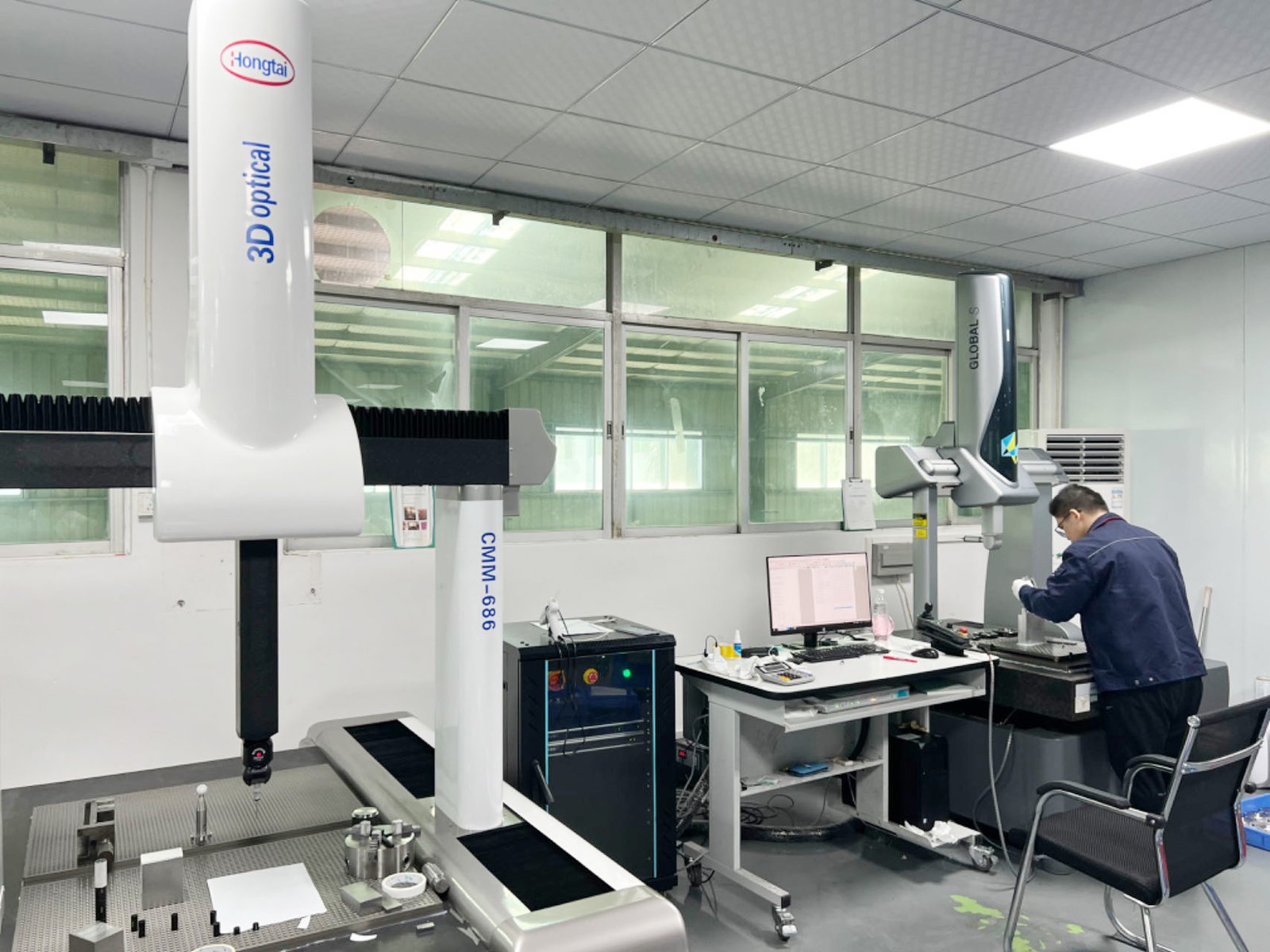
- Ask what is measured and what ships. First-article inspection against the drawing, in-process checks, CMM reports on critical features, and process capability of Ppk ≥ 1.67 at the initial study on key characteristics and Cpk ≥ 1.33 on general characteristics. Capability is reported per characteristic: every report names the feature, its tolerance band, the sample size, the sigma method, and the study window are the marks of a recorded process. The material certificate should travel with the parts, and the passivation or electropolish treatment should ship with its own record.
- Ask how a delivered part can be confirmed as 316, not 304. The answer should include the lot-level XRF record and the mill certificate chain, not a color or a spark test. A supplier that can trace a finished part back to a verified lot is a supplier you can audit after the fact.
Scale is part of the answer. The plant behind this guide runs 100+ CNC machines across milling, turning, mill-turn, and grinding in a 6,800 m² facility with 100+ staff, so a stainless order is machined, treated, and inspected under one roof rather than handed between sub-suppliers. The quality system behind the facility holds the detail; the short version is that the grade, the tolerance, and the surface treatment are each measured, recorded, and shipped with the part.
Frequently Asked Questions
Which stainless steel grades do you machine?
We machine 303, 304, 316, 316L, and 17-4 PH. 303 runs when free machining matters more than peak corrosion resistance, 304 is the general-purpose default, 316 and 316L cover chloride and marine exposure, and 17-4 PH covers high-strength parts machined in Condition A and aged after machining.
What tolerances can stainless machining hold?
Precision turning and milling hold ±0.003 mm on critical stainless features, with precision grinding at ±0.002 mm for bearing seats and sealing surfaces that need it. Critical dimensions are verified on an in-house CMM, and key characteristics are held to Ppk ≥ 1.67 initial.
Is 303 as corrosion-resistant as 304?
No. 303 adds sulfur to improve machinability, and that addition lowers its corrosion resistance and can leave it more prone to pitting in chlorides. Choose 303 only when the machining benefit matters and the service environment is moderate; for marine or chemical duty, 304 or 316 is the honest spec.
Can stainless steel parts be anodized?
No. Anodizing builds an oxide layer on aluminum; stainless already forms its own chromium oxide film, so the equivalent treatments are passivation and electropolishing. A stainless drawing that calls for anodize should be corrected to name the actual surface treatment required.
How can I confirm the parts I receive are really 316 rather than 304?
Ask for the lot record: the mill certificate naming the grade, the XRF verification performed at intake, and the batch identity that ties the finished parts to that lot. Dimensional inspection cannot see chemistry, so the material record is the only proof that travels with the order.
Can you machine a single stainless prototype before production?
Yes — MOQ is one piece. Prototypes run on the same machines, tolerances, and documentation as production, so the part and its first-article report are a true preview of the production run rather than a separate, looser process.
Which certifications does the shop hold?
Dongguan Zhuohang Ltd holds ISO 9001:2015 (No. 116024/A/0001/UK/En), IATF 16949:2016 (product design excluded) (No. 131941/A/0001/SM/En), and ISO 14001:2015 (No. 116024/B/0001/UK/En). IATF scope is build-to-print, so the certificates are verifiable by number rather than by claim.
Need a stainless part machined and verified to its grade?
Send the drawing with the grade callout and we will return a quote with the process path, the surface treatment, and the material record included. Email [email protected] or call +86 13126536955.