
Titanium Machining: Heat, Deflection, and the Cost Physics Behind Every Quote
Titanium machining is a heat problem wearing a strength-to-weight costume. Titanium earns its place in aerospace, medical, and motorsport because it is as strong as many steels at roughly half the weight, survives corrosion and body chemistry, and does not fatigue the way lighter substitutes do. But on the machine it behaves like nothing else a job shop cuts: it conducts heat so poorly that the temperature of the cut stays in the tool, it deflects more than steel under the same load, and it costs multiples of aluminum or stainless to machine for reasons that are pure physics, not supplier markup. This guide covers which titanium grades to specify, why the material fights the tool, how round and prismatic titanium geometry should be routed, the tolerances and surfaces that actually hold, and how to verify both the supplier and the grade before you commit a premium material to a drawing.
Which Titanium Grades Should a Machining Drawing Name, and Why Does the Alloy Line Drive the Quote?
Titanium is a family of alloys divided by microstructure, and the division decides both the mechanical properties and the price. Two designations cover the overwhelming majority of machined titanium work, and a drawing should name one of them with its condition rather than leaving the shop to choose.
| Grade (designation) | Type | What it is for | Machining note |
|---|---|---|---|
| TA2 (Grade 2) | Commercially pure | Chemical and marine parts, heat exchangers, implants where purity and formability matter more than ultimate strength | Softer and gummier than the alloys; sharp tools and good coolant keep the edge from smearing |
| TC4 (Grade 5, Ti-6Al-4V) | Alpha-beta alloy | Aerospace structural parts, medical implants, high-performance automotive and motorsport components | The machining standard: stronger, harder, and better behaved than CP grades, still slow and heat-sensitive |
Grade choice moves the quote before the first tool path is written. CP titanium costs less per kilo but can be more difficult to machine cleanly because it is gummy; Ti-6Al-4V costs more per kilo but machines more predictably and carries the strength that most engineering drawings are actually specifying. If the drawing says "titanium" without a grade, the shop cannot buy the right bar, the certificate cannot name the right alloy, and the part cannot be verified later — the same three failures, in the same order, every time.
The condition matters as much as the grade. Bar stock arrives in a mill condition with its own certificate, and the drawing should state whether the mechanical requirement applies to the as-supplied condition or after any aging or stress-relief step. For a part that must hold flatness or a critical dimension after machining, the stock form — bar, plate, or forging — and its residual-stress history are engineering inputs, not procurement details.
Why Is Titanium So Hard to Machine, and Where Does the Heat Actually Go?
Titanium is not hard in the way hardened steel is hard. What makes it difficult is a combination of properties that all point the same way: the cutting edge runs hot, and the heat has nowhere to go.
- The heat stays at the tool. Titanium conducts heat poorly — a fraction of steel's conductivity — so the temperature generated by the cut concentrates at the cutting edge instead of leaving with the chip. That is why titanium is machined at a few tens of meters per minute, roughly ten times slower than aluminum, and why every additional meter per minute of speed buys tool wear instead of productivity.
- The alloy rewelds onto the edge. Titanium is chemically reactive at cutting temperature. Chips weld to the cutting edge, the edge breaks down, and the process degrades fast unless the tool is sharp, the geometry is positive, and coolant reaches the cut under real pressure. Galling and rewelding are the titanium-specific versions of the chip problems other metals cause.
- Chips do not break cleanly. Titanium produces stringy, tough chips that carry intense heat. Chip control — breakers, peck cycles in holes, high-pressure coolant — is not a refinement on titanium; it is the difference between a controlled cut and a fire risk from hot swarf.
The shop-side consequence is that titanium is priced on discipline, not speed. The tooling must be right, the machine must be rigid, and the coolant system must deliver where the cut happens. A shop that quotes titanium with the same cycle logic as stainless has not machined titanium; a shop that names the speeds, the tool geometry, and the coolant pressure has.
How Does Titanium's Flexibility Change the Tolerances You Can Hold, and Which Features Move?
Titanium is roughly half as stiff as steel, and that single fact reshapes what "tight tolerance" means on a titanium drawing. Under the same cutting force, a titanium feature deflects about twice as far as a steel one, and a thin wall or a thin ring moves away from the tool instead of holding a rigid line. The geometry that machines easily in 6061 or 4140 can chatter, spring, or push off size when the material is titanium.
Three features concentrate the risk:
- Thin walls and thin webs. The wall flexes under the cutting load, the tool rubs instead of shears, and the surface finishes rough. The answer is lighter finishing passes, stiffer fixturing, and a wall thickness the process can actually hold, which is a design decision, not a machining heroics decision.
- Thin rings and long slender diameters. The classic turned-titanium failure: a thin ring or a long shaft deflects while the tool cuts, and the part springs back to a different shape when the force is removed. It is why critical titanium diameters are machined with the work supported, measured off the machine, and finished with passes light enough that deflection stays inside the tolerance.
- Deep holes. The chip does not break, the heat does not leave, and the drill is deep in the work where neither coolant nor chip escape is easy. Deep holes in titanium are planned operations with pecking, high-pressure coolant, and tool-life expectations set in advance, not features discovered mid-run.
None of this means titanium cannot hold precision — it means the precision has to be planned. Machined titanium features hold the same ±0.003 mm band as other metals when the process is designed for the material, and the design rule is the same as everywhere in machining: thicken the wall, open the corner, and support the slender feature before the tolerance is set, not after.
Turning, Milling, or Mill-Turn: How Should Titanium Geometry Be Routed, and What Breaks First?
Titanium follows the standard geometry routing — round to the lathe, prismatic to the mill, mixed to the mill-turn — but the routing decisions carry more weight because every extra setup is another chance to mishandle an expensive, heat-sensitive material.
Turning is the least punishing home for titanium, because the cut is continuous and the tool stays engaged. A shaft or a bushing in Ti-6Al-4V turns reliably once the speed is held down and the tool stays sharp; the practical limits are long slender diameters and thin rings, which deflect and spring under the tool. The economic reality is that a turned titanium part spends its machine time slowly and deliberately, so the geometry should be designed to need as few passes as possible.
Milling is where titanium punishes interrupted cuts and light passes. Every time the cutter enters and leaves the work, the edge sees a shock, and a shallow cut that rubs instead of shears work-hardens the surface for the next pass. Titanium milling wants a rigid machine, a rigid setup, climb milling, and a depth of cut that keeps the edge cutting, which is the opposite of the timid approach many shops try first.
Mill-turn earns its keep on the mixed titanium geometry that aerospace and medical drawings love: a part with a precision bore, a flange, and drilled holes that must all sit on the same axis. Machining that part in one setup holds the bore-to-face relationship without the re-fixturing that would cost both time and accuracy on a material already priced by the minute. The process-selection logic on this site is written for exactly this decision; titanium simply makes the right answer more valuable.
The first thing to break on a titanium job is never the part — it is the plan. Shops that quote titanium without naming the process path, the tooling, and the coolant strategy are the ones whose first article arrives late and over budget.
What Tolerances and Finishes Can Titanium Machining Hold, and What Damages the Surface?
Titanium holds precision machining tolerances like other metals when the process respects the material: turning and milling to ±0.003 mm on critical features, with precision grinding to ±0.002 mm on the rare bearing or sealing surface that needs it. What changes on titanium is the surface itself, because titanium surfaces are easily damaged in ways that are invisible at the moment they happen.
- Contamination is permanent. Titanium reacts with tool material and with atmosphere at elevated cutting temperature. A dull tool or a dry cut can leave a contaminated or cracked surface layer that has to be removed before the part is acceptable, which is why surface integrity matters more than surface smoothness on titanium.
- The natural finish is already useful. Machined titanium forms a stable oxide film that gives it its corrosion resistance, so most titanium parts ship as-machined. Bead blasting evens appearance where it matters, and titanium can be anodized for identification or cosmetic color, but the coating is decorative, not protective in the way anodize protects aluminum.
- Specify Ra where it functions. Sealing faces, bearing surfaces, and implant-contacting surfaces may carry an Ra callout, and the drawing should say which surfaces earn it. The rule is the same as every material on this site: a finish is a functional requirement, not an adjective.
The surface story reinforces the tolerance story: on titanium, quality is decided by the process — sharp tools, controlled heat, clean cuts — and verified by measurement after the part is free of the fixture. That is the same discipline the quality system behind this facility applies to every material, and it is why a titanium part and its first-article report should travel together.
When Is Titanium Worth Machining, and When Does a Cheaper Material Do the Same Job?
Titanium is specified for reasons, and the reasons are measurable: strength at low weight, corrosion resistance, biocompatibility, and fatigue behavior that light alloys cannot match. The honest buyer's question is whether the part actually needs one of those reasons, because titanium machining carries a real premium at every step.
- The material costs more. Titanium bar is expensive per kilo, and machining wastes a large share of every bar as chips. That is a material bill that scales with the design, not with the supplier.
- The machine time costs more. At a few tens of meters per minute, a titanium feature takes many times the machine time of the same feature in aluminum or steel. The hourly rate is the same; the hours are not.
- The tooling costs more and dies faster. Titanium-specific tooling, coolant delivery, and insert consumption all appear in the quote. A titanium price that looks like a steel price has left something out.
When the premium is justified, it is because nothing cheaper meets the requirement: the weight saved on an aircraft bracket, the corrosion life in a chemical line, the biocompatibility of an implant, or the fatigue margin on a high-cycle part. When it is not justified, the substitution is usually visible on the drawing — an over-specified wall, an unnecessary tolerance, or a material choice made by habit rather than by requirement. The most useful question a shop can ask on a titanium RFQ is the same one a buyer should ask first: what is the property that made you pick titanium, and does this feature actually use it?
What Should a Titanium Drawing Carry Before the Quote, and How Do You Compare Two Quotes Honestly?
A titanium RFQ is where the five-dollar drawing discipline pays fifty-dollar dividends, because every ambiguity is multiplied by the most expensive material on the floor. Check that the package closes these gaps before it goes out:
- Grade, condition, and the property that justifies them. TA2 or TC4, the mill condition, and the strength or corrosion requirement that the grade is answering. The material certificate should be able to prove the alloy line.
- The geometry risks named. Thin walls, thin rings, slender diameters, and deep holes are process risks on titanium before they are drawing features. State them or let the DFM review find them — either way, they are part of the quote.
- Tolerances only where function needs them. Every ±0.003 mm feature on a titanium part is a slow, measured, expensive promise. Reserve the band for the features that control assembly and function.
- Finish and surface-integrity callouts. Ra limits on functional surfaces, and any requirement that the surface layer be free of contamination or damage. Titanium surface integrity is a drawing requirement when it matters, not a hope.
- Inspection and documentation scope. First-article inspection, CMM verification on critical features, and the material certificate that travels with the parts. On a premium material, the record is part of the product.
Comparing two titanium quotes is then a question of scope, not arithmetic: are the grades the same, are the tolerances and inspection the same, are the finish and documentation the same, and does the process path actually hold the datums? A quote that names grade, process, tooling, and inspection is a plan; a quote that names a price is a number waiting to be revised. The part-geometry read-through on this site is the framework for reading both.
How Do You Verify a Titanium Machining Supplier, and the Grade in the Finished Part?
Titanium is a small market with a large price spread, which makes grade substitution and certificate laundering real risks. The verification questions that matter are the ones that test the material record:
- Ask how the alloy is verified at intake. A controlled shop checks incoming titanium against the mill certificate with an XRF spectrometer before it reaches a machine. The facility behind this guide runs that check on every incoming lot, because a printed grade is not a verified lot.
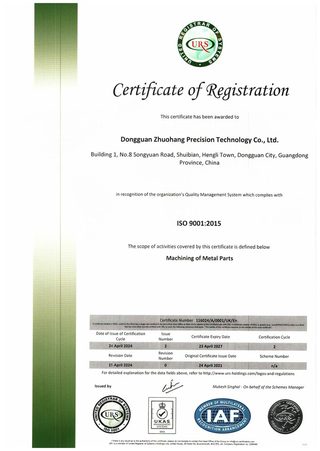
- Ask for certificate numbers, not certificate names. ISO 9001 and IATF 16949 (product design excluded) claims are auditable by number. Ours are ISO 9001:2015 (No. 116024/A/0001/UK/En), IATF 16949:2016 (product design excluded) (No. 131941/A/0001/SM/En), and ISO 14001:2015 (No. 116024/B/0001/UK/En), held by Dongguan Zhuohang Ltd, founded in 2005.
- Ask what is measured and what ships. First-article inspection against the drawing, in-process checks, CMM reports on critical features, and process capability of Ppk ≥ 1.67 at the initial study on key characteristics and Cpk ≥ 1.33 on general characteristics. Capability is reported per characteristic: every report names the feature, its tolerance band, the sample size, the sigma method, and the study window are the marks of a controlled process. The mill certificate, tied by lot number to the finished parts, should ship with the order.
- Ask about the process plan, not just the machine. Speeds in the right range, tool geometry, coolant pressure, and how deep holes and thin walls are handled are the answers that reveal whether a shop has cut titanium or has only quoted it.
Scale completes the picture. The plant behind this guide runs 100+ CNC machines across milling, turning, mill-turn, and grinding in a 6,800 m² facility with 100+ staff, so a titanium order is machined, inspected, and documented under one roof rather than handed between sub-suppliers. When a buyer asks whether a shop can actually make a titanium part and prove the grade, the answer lives in the material record and the process plan, and both should be on the table before the first chip is cut.
Frequently Asked Questions
Which titanium grades do you machine?
We machine TA2 (Grade 2) and TC4 (Grade 5, Ti-6Al-4V). TC4 covers most engineering work — aerospace, medical, and high-performance parts — while TA2 is used where purity and formability matter more than ultimate strength. Incoming stock is verified by XRF against its mill certificate before it reaches a machine.
What tolerances can titanium machining hold?
Precision turning and milling hold ±0.003 mm on critical titanium features, with precision grinding at ±0.002 mm for the rare bearing or sealing surface that needs it. Critical dimensions are verified on an in-house CMM, and key characteristics are held to Ppk ≥ 1.67 initial.
Why does titanium machining cost so much more than steel?
Because the material is expensive and the machine time is long. Titanium is cut at a few tens of meters per minute — roughly ten times slower than aluminum — because it conducts heat so poorly. That slow cut is why every titanium feature carries many times the machine time of the same feature in steel, plus higher tooling cost and the material bill for the bar and its scrap.
Is titanium magnetic?
No. Titanium and its common alloys are essentially non-magnetic, which is why the material is used for implants, instruments, and parts that sit near sensors or in MRI environments. If non-magnetic behavior is a functional requirement, write it on the drawing so the grade and the verification reflect it.
Can thin titanium walls and rings be machined to tolerance?
Yes, when the process is planned for them. Titanium deflects more than steel under cutting load, so thin features are machined with light finishing passes, stiff fixturing, and support for slender work, then measured off the machine. The tolerance is held by the process plan, not by hoping the material behaves like steel.
Can you machine a single titanium prototype before production?
Yes — MOQ is one piece. Prototypes run on the same machines, tolerances, and documentation as production, so the part and its first-article report are a true preview of the production run rather than a separate, looser process.
Which certifications does the shop hold?
Dongguan Zhuohang Ltd holds ISO 9001:2015 (No. 116024/A/0001/UK/En), IATF 16949:2016 (product design excluded) (No. 131941/A/0001/SM/En), and ISO 14001:2015 (No. 116024/B/0001/UK/En). IATF scope is build-to-print, so the certificates are verifiable by number rather than by claim.
Have a titanium part that needs machining, and proving its grade?
Send the drawing with the grade callout and we will return a quote with the process plan, the tooling, and the material record included. Email [email protected] or call +86 13126536955.