
5 Axis Machining: When Two Extra Rotary Axes Stop Costing and Start Paying
5 axis machining is the most capable configuration a machine shop owns, and it is also the one most often oversold. A 5-axis machine adds two rotary axes to the three linear ones, letting the tool approach the part from nearly any angle, which means compound-angle features, undercuts, and sculpted surfaces can be machined in one setup instead of being indexed, flipped, and re-fixtured across several. The capability is real, and so is the hourly rate that comes with it. The engineering question is not whether 5-axis machining exists in a shop but whether your part uses the fifth axis, or whether a cheaper configuration would hold every tolerance on the drawing. This guide covers what the fifth axis unlocks, the difference between 3+2 positioning and full simultaneous 5-axis work, the parts that genuinely need it, and how to verify a shop's 5-axis claim before you send a drawing.
What Does a Fifth Axis Unlock, and Where Does a Fourth Axis Fall Short?
A 4-axis machine rotates the part about one axis, which handles radial features, multiple faces, and cylindrical work. A 5-axis machine adds a second rotary axis, and with it the tool can tilt as well as the part rotate. That tilt is the difference between reaching a feature and not being able to reach it at all.
- Compound angles. A boss, a port, or a mounting face angled in two planes at once — the kind of feature a 4-axis setup can only reach with an angled fixture, if it can reach it at all — is cut directly on a 5-axis machine because the tool can orient to the feature.
- Undercuts and recessed features. Geometry behind a wall or inside a pocket that no straight tool can reach from a standard direction becomes accessible when the tool tilts into the space. This is where 5-axis displaces work that would otherwise need EDM or a series of clever, expensive fixtures.
- Freeform and sculpted surfaces. Impellers, mold cavities, turbine blades, and ergonomic housings need the tool to stay nearly normal to a changing surface. A 5-axis machine keeps the tool oriented to the surface, which improves finish and lets the cutter work efficiently instead of dragging across it.
- One-setup accuracy on complex parts. A part that would need five or six 3-axis setups — each with its own clamp, its own error, and its own chance of a collision — is machined in one setup on a 5-axis center, with every feature holding position from the same datum.
The honest boundary is the same one drawn in the companion guide to 4 axis machining: if every feature on the part points at, or around, a single axis of rotation, the fourth axis earns its keep and the fifth axis is idle capability. The fifth axis pays when features point in compound directions, which is why the geometry, not the brochure, decides the machine.
3+2 Positioning vs Full 5-Axis: What Is the Difference, and Which Do You Need?
"5-axis" is two different capabilities wearing the same name, and the difference matters to both the quote and the part. Understanding it prevents paying for full simultaneous motion on a part that only needs positioning, or expecting positioning to cut a surface it cannot.
3+2 machining (positioned 5-axis) uses the two rotary axes to tilt and lock the part into an orientation, then cuts with the three linear axes. It is the workhorse mode for most 5-axis production: machine one face, tilt to the next angle, lock, and cut. The benefit over 3-axis is fewer setups and better cross-feature accuracy; the benefit over full 5-axis is that the motion is simpler, the programming is easier, and the process is more robust for repeated runs. If a part's features sit on a handful of fixed angles, 3+2 is usually the right answer.
Full 5-axis machining moves all five axes simultaneously while the tool is in the cut. This is what sculpted surfaces, impellers, and complex contours require — the tool must stay oriented to the surface as the part moves through all five axes at once. Full 5-axis is where the programming sophistication, the post-processor quality, and the machine's motion control all show up, and it is where the hourly rate earns its keep on parts that no positioned setup could produce.
The quote question that exposes the difference: "does this part need the tool to move while the surface is being cut, or can each feature be cut at a fixed angle?" A shop that answers by naming the features and the mode is planning the work; one that answers "we have 5-axis" has not read the drawing.
Which Parts Actually Need 5-Axis Machining, and Which Just Look Like They Do?
The part families that genuinely earn 5-axis machining share one trait: features that cannot be reached, or cannot be held accurately, in any fixed orientation. If a part looks like any of these, the fifth axis is likely a real requirement rather than a preference:
- Aerospace and defense structural parts. Brackets, housings, and frames with compound-angle mounting faces, deep pockets, and lightened webs that must hold tight tolerances between features on different planes.
- Impellers, blisks, and fluid-handling components. Twisted, thin airfoils and vanes that require the tool to follow a changing surface — the classic full-5-axis geometry that no positioned setup can cut.
- Mold and die cavities. Sculpted cavity surfaces with compound draft and undercut regions, where 5-axis reduces or removes the hand-finishing and EDM work that a 3-axis cavity would need.
- Medical implants and instruments. Anatomical contours, compound-angle screw bosses, and complex instrument geometry in titanium and 316L, machined in one setup to protect both accuracy and surface integrity.
- Complex housings and robotic components. Parts with bores, faces, and ports on many planes, where the alternative is a cascade of setups and the error that travels with each one.
What does not need 5-axis is a part with a handful of fixed-angle features that a 3+2 setup or a 4-axis machine with one angled fixture can reach. Quoting that part on a full 5-axis center adds machine-hour cost for capability the geometry never asks for. The same judgment in reverse is worth stating plainly: a part with genuinely compound geometry is not cheaper because a shop quotes it on 3-axis with heroic fixtures — it is riskier, slower, and more likely to miss the tolerance. Fit is the whole game.
What Does a 5-Axis Machining Drawing Look Like, and Where Does GD&T Decide?
A 5-axis drawing is not a special document — it is a normal engineering drawing with the geometry and tolerances stated precisely enough that the process can be chosen correctly. Three elements carry most of the weight.
- A datum scheme that controls compound relationships. If features on different planes must hold position to each other, the drawing needs a datum reference frame that ties them together. That is what tells the shop which features to machine from which setup, and whether one 5-axis setup or several simpler ones will hold the tolerances.
- Tolerances on the features that actually assemble. A compound-angle mounting face usually needs position or profile control relative to the functional datums, not a stack of angular dimensions that each carry their own error. The tighter and more functional the relationship, the stronger the case for one-setup 5-axis machining.
- Surface finish where the surface functions. On a sculpted surface or a sealing face, the Ra callout should sit where the surface seals, bears, or flows. Full 5-axis finishing can hold fine finishes on freeform surfaces because the tool stays oriented to the work; the drawing should say which surfaces earn that cost.
None of this means 5-axis rescues a poorly designed part. Thin walls still chatter, sharp internal corners still force small cutters, and over-toleranced drawings still cost money — on a 5-axis machine, they just cost it faster. The drawing discipline that protects a budget on a 3-axis part protects it even more on a 5-axis one, because the machine-hour is more expensive and the program is more complex.
When Does 5-Axis Replace Another Process, and When Does It Not?
The arrival of capable 5-axis machining has moved work that used to belong to other processes, and knowing where the boundaries sit keeps a quote honest.
- Replacing multiple 3-axis setups. This is the most common and most valuable swap. A housing that needed five fixtures and five programs on a 3-axis floor is machined in one 5-axis setup with every feature on the same datum — less time, less error, fewer chances for a mistake.
- Replacing some EDM work. Undercuts and recessed features that once had to be burned with a sinker EDM because no cutter could reach them are now cut directly when the tool can tilt into the space. EDM still owns hardened materials, fine internal corners, and features no rotating tool can produce — 5-axis shrinks its territory but does not eliminate it.
- Replacing 4-axis work, sometimes. A part with one tilted feature among a body of radial work might run on a 4-axis center with a single angled fixture, or on a 5-axis with no fixture compromise. The decision is economic: whether the 5-axis hour and the simpler fixture beat the 4-axis hour plus the fixture design.
- What it does not replace. 5-axis does not replace turning for round parts, does not make a thin wall rigid, and does not remove the need for good work-holding, good tooling, or a DFM review. It is a capability that sits on top of the same process discipline, not a substitute for it.
The process conversation worth having with a shop is on the process-selection guide: which path the geometry calls for, where the datums sit, and which machine configuration holds them. For a complex housing, that answer may be 5-axis; for a round part, it is still a lathe, and a shop that knows the difference is reading the part, not the brochure.
What Does 5-Axis Machining Cost, and When Does the Hourly Rate Pay for Itself?
5-axis machine-hours cost more than 3-axis or 4-axis hours, and the total cost story is about what the higher rate buys. It buys fewer setups, fewer fixtures, tighter cross-feature relationships, and in some cases the only way to make the part at all.
- The rate premium is real. A 5-axis center is a bigger capital investment, a more complex program, and a more skilled setup. The hourly rate reflects that, and any quote comparison has to account for it.
- The payback is in setups and yield. A part that needs one 5-axis setup instead of five 3-axis setups removes four operator hours, four fixtures, and four chances for a clamping error. On complex prismatic work, the higher rate is usually the cheaper total — the setup count is where the savings hide.
- The payback is in geometry nothing else can make. An impeller or a compound-angle housing is not "more expensive on 5-axis" — it is unmakeable, or only makeable with heroic fixture work and EDM follow-up, any other way. On those parts the 5-axis rate is the price of entry, not a premium.
- The risk is overspecification. A simple two-plane bracket on a full 5-axis center is a waste of the rate; a 3+2 or 4-axis answer would hold the tolerance for less. The quote that matters names the mode — 3+2 versus full simultaneous — and explains why your part needs it.
The comparison rule for a 5-axis job is the same as everywhere on this site: compare scope, not just price. Same features, same tolerances, same inspection, same finish scope — then the axis decision explains itself.
How Do You Verify a 5-Axis Machining Supplier — Beyond the Brochure?
5-axis is the capability claim most often padded in machining marketing, and it is also the easiest to verify with the right questions.
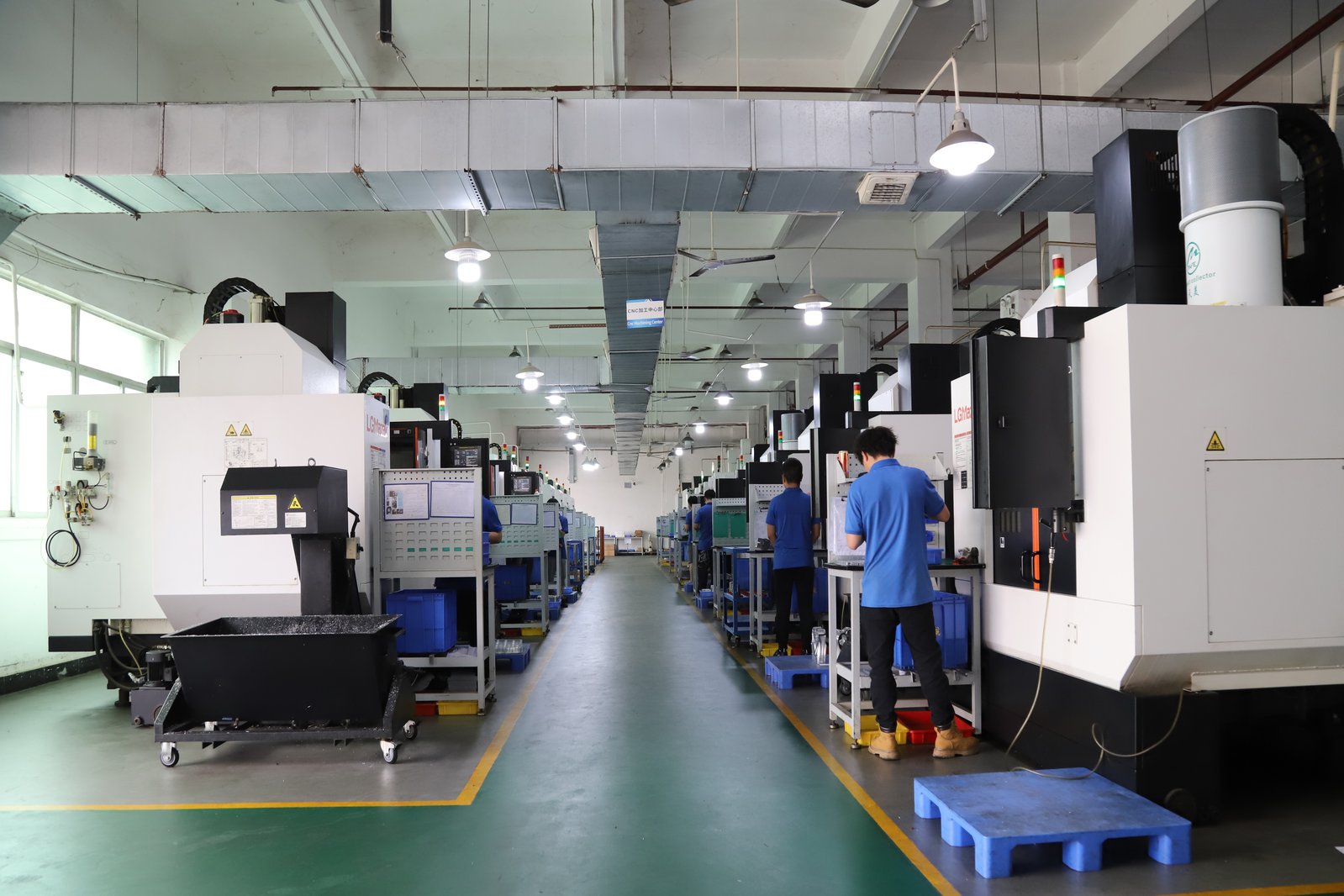
- Ask for the machine list by axis count and configuration. A serious shop states how many 3-axis, 4-axis, and 5-axis machines it runs and what kind they are. The facility behind this guide runs 100+ CNC machines, including 20+ 5-axis mills, in a 6,800 m² plant with 100+ staff.
- Ask whether your part is 3+2 or full 5-axis, and why. A shop that names the mode and ties it to your features is planning the program. One that answers "we have 5-axis" has not read the drawing.
- Ask how programs and post-processors are handled. Full 5-axis work lives or dies on the CAM post-processor and the machine's motion control. A shop that can name its CAM system and describe how it validates toolpaths before cutting is a shop that treats 5-axis as engineering, not as a machine name.
- Ask what is measured and how. Probing on the machine, first-article inspection, CMM verification of critical features, and capability data on key characteristics are the evidence. The facility holds ISO 9001:2015 (No. 116024/A/0001/UK/En), IATF 16949:2016 (product design excluded) (No. 131941/A/0001/SM/En), and ISO 14001:2015 (No. 116024/B/0001/UK/En), verifiable by number.
The factory capability page carries the full machine picture, and the quality system page carries the measurement discipline. Between them, they answer the only question that matters: can this shop machine a 5-axis part correctly and prove it, or is it quoting a machine it can name but not operate?
Frequently Asked Questions
What is 5-axis machining?
5-axis machining uses a machine with three linear axes (X, Y, Z) plus two rotary axes, so the tool can approach the part from nearly any angle. It machines compound angles, undercuts, and sculpted surfaces in one setup, either by positioning the part at fixed angles (3+2) or by moving all five axes while cutting.
What is the difference between 3+2 and full 5-axis machining?
3+2 machining tilts the part to a fixed angle, locks it, and cuts with the three linear axes — the right mode for features on a handful of fixed planes. Full 5-axis moves all five axes simultaneously during the cut, which is required for sculpted surfaces, impellers, and contours where the tool must stay oriented to the surface.
When does a part actually need 5-axis machining?
When features point in compound directions that no fixed orientation can reach — compound-angle mounting faces, undercuts, freeform surfaces, and complex parts whose cross-feature tolerances demand one setup. If every feature points at or around one axis, a 4-axis or 3+2 setup usually does the job for less.
What tolerances can 5-axis machining hold?
Machined features hold ±0.003 mm on critical callouts, with precision grinding at ±0.002 mm where bearing and sealing surfaces demand it. The one-setup accuracy of 5-axis work protects cross-feature relationships, and critical dimensions are verified on a CMM with key characteristics held to Ppk ≥ 1.67 initial.
Is 5-axis machining always more expensive?
The hourly rate is higher, but the total cost is often lower on complex parts, because one 5-axis setup replaces several 3-axis setups, fixtures, and the error that travels with each one. The axis decision is economic: the higher rate pays for itself when it removes setups or makes geometry that nothing else can produce.
Can you machine a single 5-axis prototype before production?
Yes — MOQ is one piece. Prototypes run on the same machines, tolerances, and documentation as production, so the part and its first-article report are a true preview of the production run rather than a separate, looser process.
Which certifications does the shop hold?
Dongguan Zhuohang Ltd holds ISO 9001:2015 (No. 116024/A/0001/UK/En), IATF 16949:2016 (product design excluded) (No. 131941/A/0001/SM/En), and ISO 14001:2015 (No. 116024/B/0001/UK/En). IATF scope is build-to-print, and the certificates are verifiable by number rather than by claim.
Not sure whether your part earns a fifth axis, or a cheaper one?
Send the drawing and we will return a quote with the axis decision explained: 3+2 or full 5-axis, the setup count your geometry needs, and the tolerances that decide it. Email [email protected] or call +86 13126536955.